
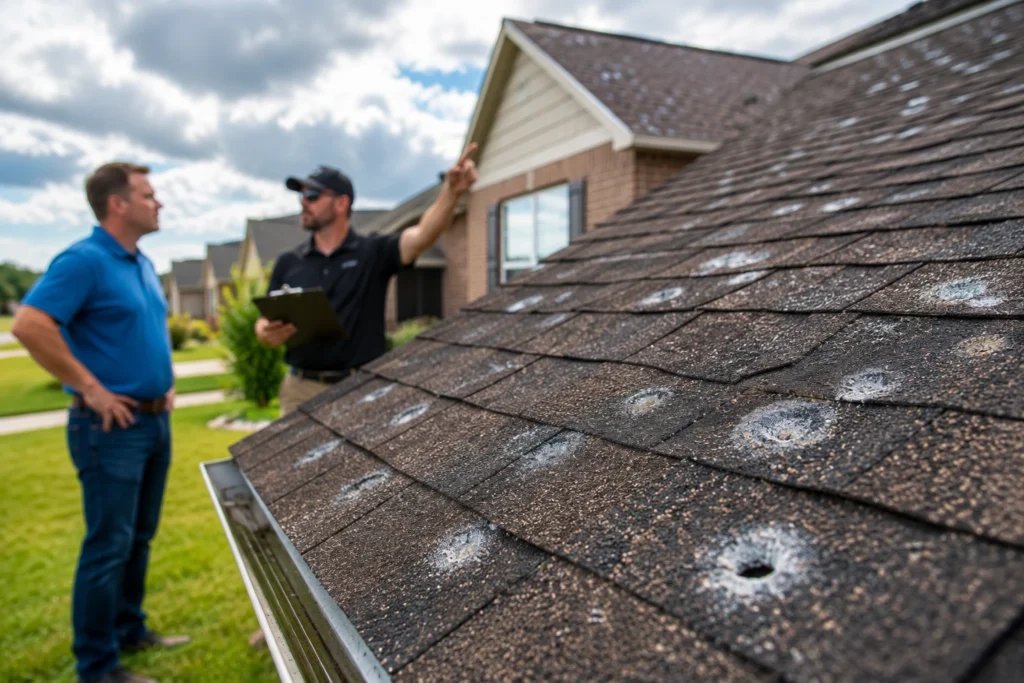
When a major hailstorm hits Friendswood, homeowners often find themselves facing an unfamiliar and stressful process. Roof damage, dented gutters, broken vents, damaged siding, and interior leaks can quickly turn a weather event into a significant financial concern. During this process, many property owners hear two terms repeatedly: public adjuster and insurance adjuster. Understanding the difference between these professionals is critical. In fact, choosing the right type of representation can dramatically affect how your claim is documented, evaluated, and ultimately settled. That is why the topic of Public Adjuster vs. Insurance Adjuster for Hail Claims in Friendswood, TX deserves careful attention.
Many homeowners assume every adjuster involved in a claim is working on their behalf. Unfortunately, that assumption can lead to confusion. While both professionals may inspect damage and discuss repairs, their roles, responsibilities, and objectives are very different. If you’ve recently experienced hail damage in Friendswood, this guide will help you understand how each adjuster operates, what they do during the claims process, and how to determine which option may be right for your situation.
Why Hail Damage Claims Are So Common in Friendswood
Friendswood homeowners are no strangers to severe weather. Located near the Gulf Coast, the area regularly experiences thunderstorms capable of producing damaging hail, strong winds, and heavy rain. While hailstones may only fall for a few minutes, the resulting damage can last for years if not properly identified and repaired.
The challenge is that hail damage is not always obvious. Some impacts leave visible dents and fractures. Others create hidden damage that weakens roofing materials over time. A roof may appear functional immediately after a storm but still suffer significant deterioration beneath the surface.
Common hail-related damage includes:
- Shingle bruising
- Granule loss
- Cracked roofing materials
- Damaged flashing
- Denting on gutters and downspouts
- HVAC condenser damage
- Broken skylights
- Water intrusion
Because repair costs can quickly climb into the tens of thousands of dollars, the quality of the claim investigation becomes extremely important.
Understanding the Insurance Claim Process
Before comparing adjusters, it helps to understand the basic claim process.
Step One: Damage Discovery
Most claims begin when a homeowner notices signs of storm damage or schedules an inspection after a hail event.
Common warning signs include:
- Missing shingles
- Water stains
- Dented metal surfaces
- Loose roofing components
- Leaks in the attic
Once damage is suspected, the insurance carrier is notified.
Step Two: Claim Assignment
After a claim is opened, the insurance company assigns an adjuster to investigate the loss. This professional evaluates the property and prepares an estimate.
Step Three: Inspection
The adjuster visits the property and documents observed damage. Measurements, photographs, notes, and observations become part of the claim file.
Step Four: Coverage Review
The insurance company reviews policy language and determines what damages qualify for coverage.
Step Five: Settlement
The carrier issues a payment, partial payment, or denial depending on its findings. At first glance, the process appears straightforward. However, significant differences often emerge when evaluating the scope of damage and repair costs. That is where the discussion of Public Adjuster vs. Insurance Adjuster for Hail Claims in Friendswood, TX becomes especially important.
What Is an Insurance Adjuster?
An insurance adjuster is a professional assigned to investigate insurance claims.
Their responsibilities typically include:
- Inspecting damage
- Reviewing policy coverage
- Preparing repair estimates
- Documenting findings
- Recommending settlement values
Insurance adjusters play a necessary role within the claims process. Without them, insurers would have no practical way to evaluate thousands of claims each year. However, homeowners should understand who these professionals represent.
Types of Insurance Adjusters
There are generally two categories.
Staff Adjusters
Staff adjusters are direct employees of the insurance company. They handle claims exclusively for that carrier.
Independent Adjusters
Independent adjusters are contractors hired by insurance companies during periods of high claim volume. Large hailstorms often create claim surges that require additional personnel. Although independent adjusters are not direct employees, they still work on behalf of the insurance carrier that hired them.
Who Does the Insurance Adjuster Represent?
This is where confusion often occurs. Insurance adjusters represent the insurance company. Their job is to investigate the claim and determine what the insurer believes is owed under the policy. That does not automatically mean they are acting unfairly. However, their role is not the same as an advocate hired specifically by the homeowner. Understanding this distinction helps establish realistic expectations throughout the claim process.
What Is a Public Adjuster?
A public adjuster is a licensed insurance claims professional who represents policyholders rather than insurance companies. Their focus is entirely different. Instead of evaluating the claim for the insurer, they work on behalf of the property owner.
Services commonly include:
- Reviewing policy provisions
- Documenting damages
- Preparing detailed estimates
- Gathering evidence
- Managing claim communications
- Negotiating settlements
In short, they serve as the homeowner’s representative during the claim process.
Why Homeowners Hire Public Adjusters
Most homeowners file very few insurance claims during their lives. Insurance companies, by contrast, process claims every day. Many policyholders feel overwhelmed by the complexity of documentation, inspections, estimates, and negotiations. A public adjuster helps bridge that experience gap. This is particularly valuable when hail claims involve substantial damage or disputed findings.
Public Adjuster vs. Insurance Adjuster for Hail Claims in Friendswood, TX
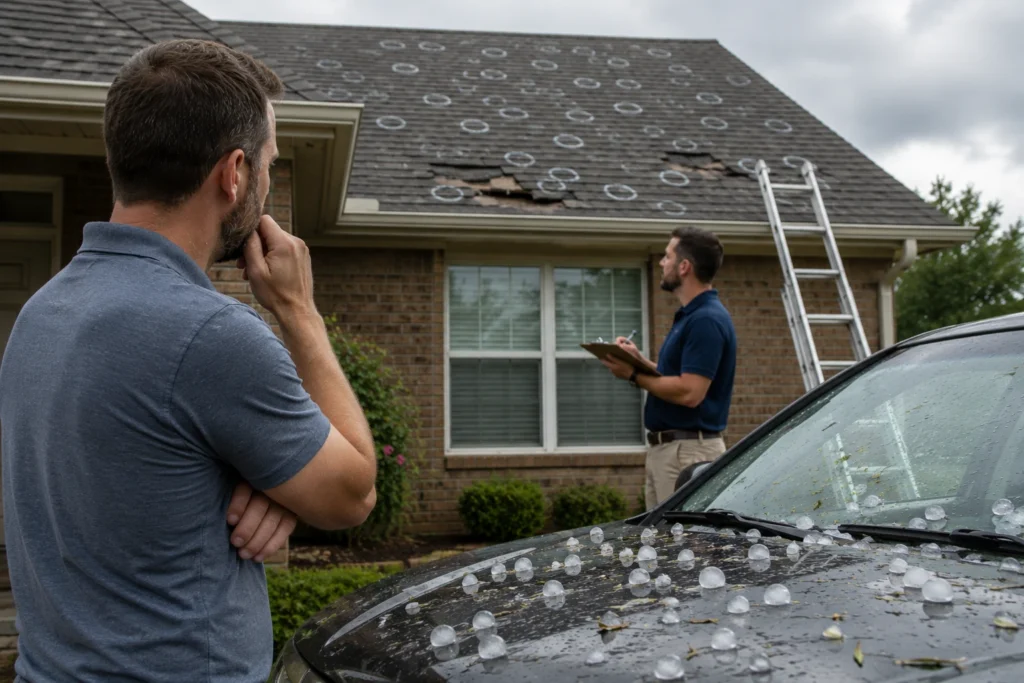
Let’s compare the two side-by-side.
| Category | Insurance Adjuster | Public Adjuster |
| Hired By | Insurance Company | Property Owner |
| Represents | Insurance Carrier | Policyholder |
| Primary Goal | Evaluate Claim | Advocate for Claim |
| Payment Source | Insurance Company | Homeowner |
| Damage Documentation | Reviews Damage | Builds Comprehensive Claim |
| Negotiation Role | Represents Carrier | Represents Homeowner |
| Settlement Discussions | Limited to Carrier Position | Focused on Policyholder Interests |
| Claim Management | Carrier Directed | Homeowner Directed |
Neither role is inherently bad. The key is understanding that they serve different interests.
How Each Adjuster Approaches a Hail Claim
Imagine two professionals inspecting the same Friendswood property. The hailstorm is identical. The roof is identical. The policy is identical. Yet their evaluations may differ significantly. Why? Because the approach often differs.
Insurance Adjuster Approach
An insurance adjuster generally focuses on:
- Verifying covered damage
- Determining repairability
- Estimating costs
- Applying policy provisions
The process is designed for efficiency. During active storm seasons, adjusters may inspect numerous properties each day.
Public Adjuster Approach
A public adjuster often takes a broader view.
Their investigation may include:
- Extensive roof documentation
- Contractor consultations
- Additional photographs
- Review of local code requirements
- Identification of omitted components
- Verification of material matching issues
The objective is to build the strongest possible claim file supported by evidence.
Common Areas Frequently Missed in Hail Claims
One of the biggest sources of claim disputes involves overlooked damage. Not every missed item results from negligence. Some forms of damage are simply difficult to identify.
Roofing Accessories
Commonly overlooked components include:
- Flashing
- Ridge caps
- Vent covers
- Drip edge
- Pipe boots
These items often require replacement when roofing systems are repaired.
Soft Metals
Soft metals frequently tell the story of the storm.
Examples include:
- Gutters
- Downspouts
- Roof vents
- Flashing
- Metal roof accessories
Because hail leaves visible dents on metal surfaces, these impacts can help establish storm intensity.
Hidden Roof Damage
Some damage remains concealed beneath the surface.
Examples include:
- Granule displacement
- Mat fractures
- Delamination
- Bruising
These conditions may require closer inspection to identify properly.
Interior Damage
Many homeowners focus exclusively on exterior damage. That can be a mistake.
Roof impacts sometimes lead to:
- Moisture intrusion
- Attic leaks
- Ceiling stains
- Damaged insulation
- Interior drywall deterioration
A complete claim should consider the entire property.
Why Estimates Sometimes Differ
A common question homeowners ask is simple: How can two professionals inspect the same property and produce different estimates? Several factors contribute.
Inspection Scope
One inspection may focus primarily on visible damage. Another may involve a more comprehensive evaluation.
Repair Methodology
Different professionals sometimes disagree regarding whether materials should be repaired or replaced.
Code Requirements
Local building requirements can influence reconstruction costs.
Additional Components
Some estimates include related roofing accessories while others may not.
Supplemental Discoveries
Damage discovered during repairs often leads to additional estimates and negotiations. This is where Hail Damage Claim Supplements frequently become part of the process. Supplement requests can address damage that was not initially visible during the first inspection.
When a Public Adjuster May Make Sense
Not every claim requires a public adjuster. However, certain situations often justify additional representation.
Large Losses
The larger the claim, the greater the financial consequences. Even relatively small omissions can significantly impact settlement values.
Denied Claims
When coverage has been denied, homeowners often benefit from a detailed review of both the damage and policy language.
Underpaid Claims
A low estimate does not automatically mean bad faith. However, discrepancies deserve investigation.
Complex Damage
Claims involving multiple structures, extensive roofing systems, or commercial properties often become more complicated.
Limited Time
Managing inspections, paperwork, estimates, and negotiations can become a full-time job. Many homeowners simply do not have the time available.
When a Public Adjuster May Not Be Necessary
Balanced discussions matter. Not every claim requires outside representation.
Examples may include:
- Minor damage claims
- Small repair projects
- Fully approved settlements
- Straightforward losses with clear documentation
If the carrier has identified all damages accurately and provided fair compensation, additional representation may offer limited value. Every situation should be evaluated individually.
How Public Adjusters Are Paid in Texas
Most Texas public adjusters work on a contingency fee basis. This means compensation is typically tied to claim recovery rather than hourly billing.
Before signing any agreement, homeowners should understand:
- Fee percentages
- Contract terms
- Service scope
- Cancellation provisions
- Communication expectations
Always verify licensing credentials before hiring any claims professional.
Questions Every Friendswood Homeowner Should Ask
The quality of the questions often determines the quality of the answers.
Questions for Insurance Adjusters
Ask:
- What damage was identified?
- What was excluded?
- Why was it excluded?
- How was repairability determined?
- What documentation supports the estimate?
Questions for Public Adjusters
Ask:
- How many hail claims have you handled?
- Are you licensed in Texas?
- What services are included?
- How often will updates be provided?
- How are fees calculated?
Clear communication prevents misunderstandings later.
Red Flags During Any Hail Claim
Regardless of who is involved, certain warning signs deserve attention.
Incomplete Inspections
A brief inspection may overlook important details.
Missing Documentation
Photographs and written findings matter. Always request copies.
Pressure to Settle Quickly
Large financial decisions deserve careful evaluation.
Lack of Written Explanations
Verbal explanations are helpful. Written explanations are better.
Unlicensed Representatives
Always verify professional credentials. This simple step can prevent significant problems.
The Importance of Documentation
Documentation often becomes the foundation of a successful hail claim.
The strongest claim files typically include:
- High-resolution photographs
- Drone imagery
- Contractor inspections
- Weather reports
- Repair estimates
- Maintenance records
- Communication logs
Think of documentation as evidence.
The stronger the evidence, the stronger the claim evaluation process becomes. During complex claims, some professionals even use advanced analysis methods similar to concepts found in fields such as stochastic processes, where patterns and probabilities help explain how events develop over time. While hail claims are far more practical than mathematical theory, the principle remains similar: better information often leads to better conclusions.
Real-World Example
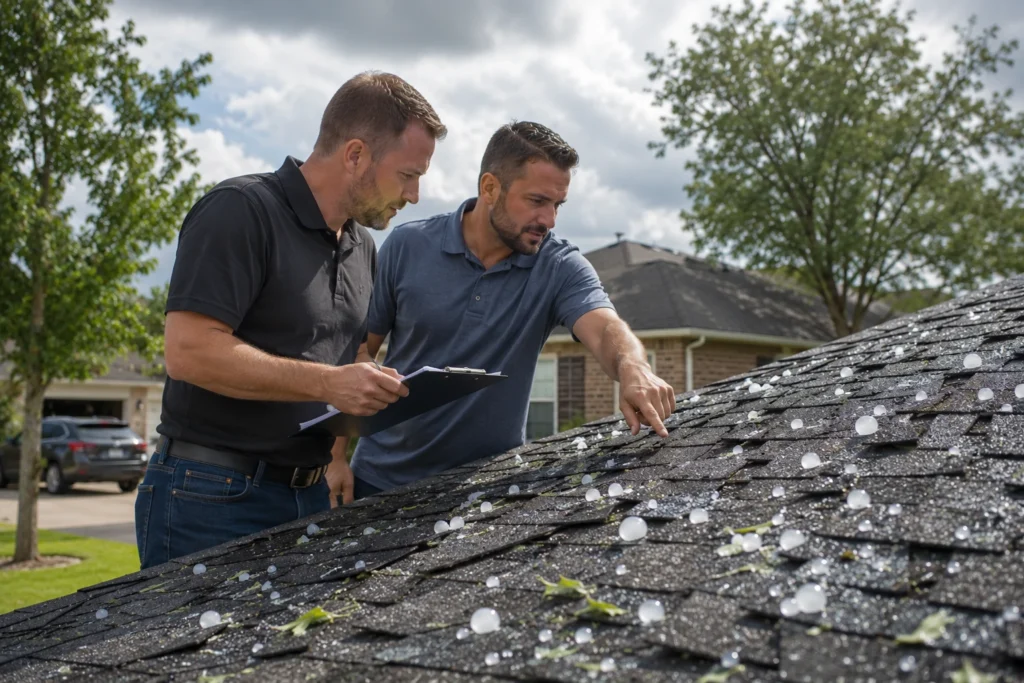
Imagine a Friendswood homeowner experiences a severe hailstorm.
The initial insurance estimate identifies:
- Roof repairs
- Gutter repairs
- Minor siding repairs
Estimated damages total $18,000.
Later, a more comprehensive review reveals:
- Damaged flashing
- Additional roof slopes
- HVAC impacts
- Code upgrade requirements
- Interior moisture damage
The revised scope reaches $33,000.
This example does not guarantee a specific outcome. However, it demonstrates how inspection scope can influence claim evaluations. The difference often lies in documentation, investigation depth, and supporting evidence.
Choosing the Right Path for Your Hail Claim
Every hail claim is unique. Some claims resolve quickly and efficiently with minimal effort. Others become complicated.
The best approach depends on several factors:
- Claim size
- Damage severity
- Property complexity
- Available documentation
- Homeowner experience
- Settlement disputes
When evaluating Public Adjuster vs. Insurance Adjuster for Hail Claims in Friendswood, TX, avoid viewing the issue as an either-or battle. Instead, focus on understanding the role each professional plays. Insurance adjusters evaluate claims for insurers. Public adjusters represent policyholders. Those are different functions. Knowing the distinction allows homeowners to make informed decisions rather than reacting emotionally during a stressful situation.
Final Thoughts
For Friendswood homeowners dealing with hail damage, knowledge is one of the most valuable tools available. The insurance claim process can feel overwhelming at first. There are inspections to schedule, estimates to review, damages to document, and decisions to make. Yet understanding the difference between the professionals involved immediately creates clarity.
The discussion surrounding Public Adjuster vs. Insurance Adjuster for Hail Claims in Friendswood, TX ultimately comes down to representation. Insurance adjusters work for insurance companies. Public adjusters work for policyholders. Both serve important roles, but they serve different interests. Before making decisions, gather documentation, ask questions, review estimates carefully, and understand exactly who is representing whom. The more informed you become, the better positioned you will be to protect your property, your finances, and your long-term recovery after a hailstorm.
FAQs
An insurance adjuster represents the insurance company, while a public adjuster represents the policyholder during the claim process.
No. Smaller, straightforward claims may not require one, but larger or disputed claims often benefit from professional representation.
Yes. A public adjuster can review the denial, document damages, and present additional evidence supporting the claim.
Yes. Public adjusters must be licensed and regulated by the Texas Department of Insurance.
Most public adjusters work on a contingency fee basis and receive a percentage of the claim recovery.
Yes. Some hail damage is difficult to identify and may not be discovered during an initial inspection.
Flashing, soft metals, roof accessories, HVAC damage, and hidden shingle bruising are frequently missed.
Yes. Many homeowners seek a public adjuster after receiving a settlement offer they believe is incomplete or insufficient.
Timelines vary, but complex claims involving supplemental damage or disputes typically take longer to resolve.
Photograph visible damage, prevent additional property damage if possible, and schedule a professional inspection as soon as practical.